Deep-Seabed Mining
Outcomes from the ISA's July 2026 Session – Continued Negotiations, Court Orders and Critical (In)Decisions
Keywords: Deep-seabed mining, ISA, Ocean Governance, Law of the Sea, Regulatory Compliance
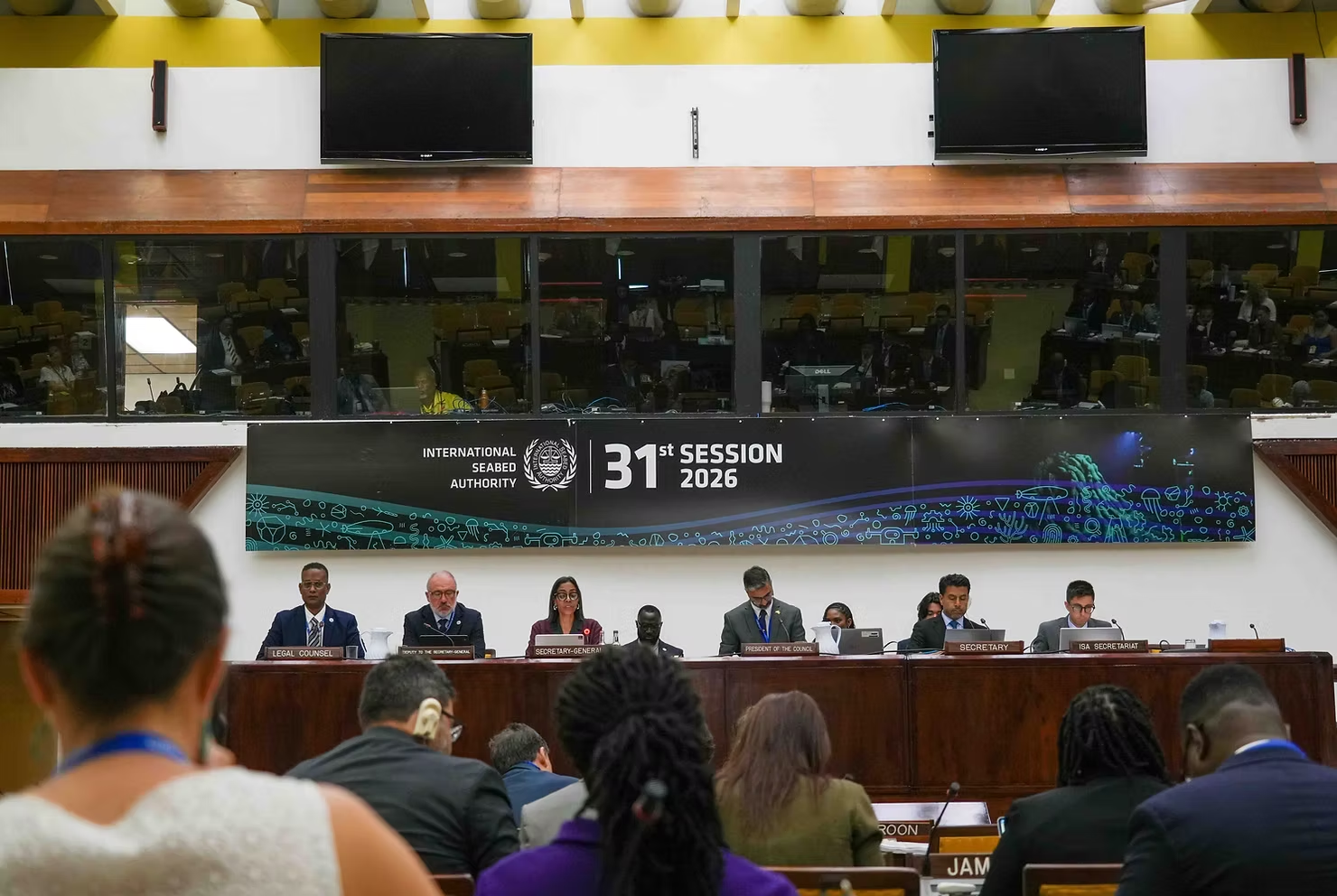
In July 2026 the International Seabed Authority (ISA), the inter-governmental body mandated to regulate deep seabed mining (DSM) in areas beyond national jurisdiction known as “the Area,” hosted the second part of its 31st session: the Council convened from 13 to 24 July 2026 and the Assembly convened from 27 to 31 July 2026. This post provides an overview of the key decisions and outcomes from this session, as well as some notable statements and discussions by ISA member States and observers, as observed by Ocean Vision Legal’s (OVL) Samantha Robb, who attended the ISA meeting in Kingston, Jamaica.
Council
Negotiations on the draft exploitation regulations continued
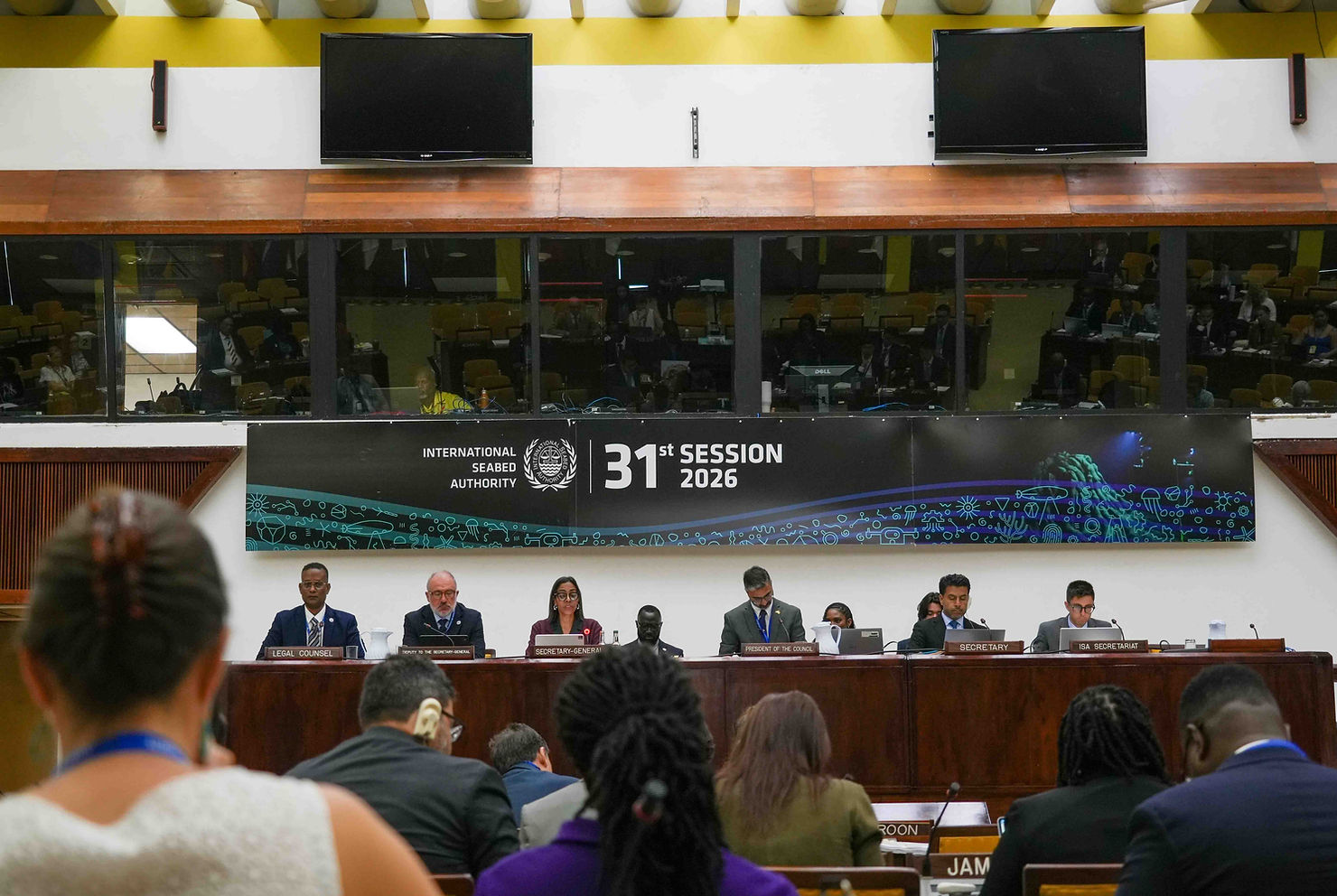
The Council continued its negotiations of the draft exploitation regulations. A new version (Revision 3 of 19 June 2026) of these regulations was published by the ISA’s secretariat, which formed the basis of these negotiations. Revision 3 mostly included textual proposals received from intersessional informal working groups since the Council’s March 2026 session, where substantive progress on complex aspects of the regulations is being made. Some of the focus areas of the ISA’s exploitation regulations this session included Annexes, environmental management and monitoring, payment system and the review of the payment system, whistleblowing protections, and effective control.
Worth mentioning was the session on underwater cultural heritage where States showed flexibility and progress towards inclusion of the term ‘underwater cultural heritage’ into the draft exploitation regulations. Ocean Vision Legal, in partnership with ISA observer, the Maui Nui Makai Network, hosted a side event during the second week of Council on ‘Living Heritage, Legal Imperatives: Integrating Indigenous Participation into Deep-Seabed Governance.’ The event brought together Indigenous voices to share their lived experiences and deep cultural connections with the Ocean, while exploring the legal foundations for Indigenous participation in Ocean governance and how the ISA can better incorporate meaningful Indigenous participation into its processes and decision-making. The event launched two Ocean Vision Legal policy briefs examining the international legal basis for Indigenous participation and recommendations for improving Indigenous engagement at the ISA.
The Legal and Technical Commission (LTC) hosted a ‘dialogue’ during the Council's first week on its work to develop environmental threshold values. The session aimed to clarify stakeholders' understanding of the LTC's ongoing efforts to identify thresholds for impacts such as toxicity, turbidity, underwater noise, and light pollution that deep-sea ecosystems may be able to withstand should mining proceed. An important take-away from this dialogue was that the LTC itself emphasised that the available data remain limited and that significant scientific knowledge gaps persist.
Significant work also still needs to be undertaken on developing necessary standards and guidelines that will accompany the draft exploitation regulation. The LTC report attached Annex I which lists 46 outstanding Standards and Guidelines at various stages of development. The Council’s decision on the LTC Report (para 22) requested the LTC to continue to develop such standards and guidelines, with the assistance of external consultants, as necessary.
Ultimately, the draft exploitation regulations remain a work in progress, with fundamental questions relating to environmental protection, compliance and benefit-sharing still unresolved.
Given the significance and potentially irreversible consequences of deep seabed mining, for both present and future generations, ensuring a robust and effective regulatory framework is more important than meeting an arbitrary timeline.
The Seabed Disputes Chamber’s Order on Provisional Meaures
In between the Council’s March and July sessions, on 30 May 2026, Nauri Ocean Resources Inc (NORI) and Tonga Ocean Mining Limited (TOML) launched legal action against the ISA (see here and here). These are the first contentious cases to be filed before the Seabed Disputes Chamber (SDC), a chamber of the International Tribunal for the Law, especially established for DSM and ISA-related disputes.
Briefly, the context for the proceedings before the SDC concerns the Council 2025 decision (paras 9 and 10) to conduct an inquiry into contractor non-compliance in July 2025, following the announcement by The Metals Company (TMC) that its subsidiary TMC US had applied for exploration and exploitation licences to the US regulator under the Deep Seabed Hard Mineral Resources Act. At the Council’s March 2026 session, a preliminary LTC report indicated that two contractors required “specific attention” in respect of possible non-compliance (see our earlier blog for further details on this contractor non-compliance inquiry). This Council 2025 decision and the preliminary LTC report led to the launching of these lawsuits. NORI and TOML argued that the ISA failed to follow fair procedures by identifying them in the LTC’s preliminary report and in sending them subsequent letters requesting further information, and that the ISA failed to exercise its powers and functions in good faith, thereby breaching their legitimate interests (for a better understanding of the main case see Lily, Singh and Pecoraro).
These proceedings included an application for provisional measures - which are always treated as urgent - and are particularly relevant for this report on the July Council session.
The provisional measures sought by NORI and TOML from the SDC were exceptionally wide-reaching: they asked the SDC to order the ISA to immediately suspend the LTC’s inquiry into their non-compliance pending the final decision of the SDC, as well as take no further steps in connection with such inquiry, including that no recommendations, findings, reports from the LTC were adopted, issued or published (see here at para 42).
NORI had submitted an application for an extension of its exploration contract in January 2026 and therefore also included a request in its application for provisional measures that the ISA be prohibited from taking any step or adopting any position, including through the LTC, that would have the effect of prejudging, refusing, or otherwise adversely affecting NORI’s extension application, insofar as such action is based on or influenced by the ongoing inquiry.
On the weekend in between the Council’s two weeks of meetings, the SDC handed down its orders in the provisional measures application (TOML order and NORI order). Note that the proceedings in the main case are ongoing.
The contractors were not granted the wide-reaching measures they sought and the ISA’s contractor non-compliance inquiry is continuing.
Finding that it had jurisdiction for the purpose of provisional measures, the SDC ordered the following in relation to the continuing inquiry:
- The ISA is required to act in accordance with the relevant legal framework, including rules of due process, in the procedures for the inquiry mandated by the Council in relation to para 9 and 10 of its 2025 decision;
- The ISA shall clarify or provide to NORI and TOML the relevant information concerning the procedures for the implementation of the Council’s 2025 decision and the subsequent questions posed to NORI and TOML so as to enable them, engaging in a constructive manner with the ISA, to respond meaningfully to the questions and within a reasonable period of time.
- The parties were ordered to cooperate and refrain from any action that might lead to aggravating the dispute.
- That the ISA and NORI and TOML are required to submit to the SDC by 31 August 2026 a report and information on compliance with the above provisional measures.

NORI’s contract extension
NORI applied for an extension for five years for their ISA exploration contract on 19 January 2026, with their current exploration contract expiring on 21 July 2026. Despite an ongoing non-compliance inquiry into their conduct, and strong public ties to TMC US, which has applied for a license outside of the ISA regime, the LTC recommended that the Council extend the contract (see LTC report section E, especially para 33).
It is important to understand the procedures followed by the ISA for contract extensions, in light of the ongoing contractor non-compliance inquiry. Contract extensions are provided for in a provision in the 1994 Part XI Implementation Agreement (section 1 para 9) (the language of which is mirrored in Regulation 26 (2) of the ISA's Nodule Regulations on Exploration), which also provides that “...Such extensions shall be approved if the contractor has made efforts in good faith to comply with the requirements of the plan of work but for reasons beyond the contractor’s control has been unable to complete the necessary preparatory work for proceeding to the exploitation stage or if the prevailing economic circumstances do not justify proceeding to the exploitation stage.”
The recommendation for extension by the LTC was based on a 2015 LTC procedure and on a 2015 Council decision referring to procedures and criteria for extensions for exploration contracts, where a divergence of views was noted by the LTC as to whether an assessment of a contractor’s “good faith” should be implicit in a decision to extend a contract. The prevailing view was that such an assessment was not required.
Also highly relevant to this context is that during the provisional order hearings at the SDC, the ISA gave an undertaking that a strict separation between the two procedures will be maintained and the SDC noted such assurances in its order (see paras 209 - 210 of the NORI Order).
Accordingly, NORI’s contract extension was granted by the Council on 21 July 2026. However, in approving NORI’s contract extension, many Council members indicated that such approval does not prejudice the non-compliance inquiry in any way.
This caveat was also included into the Council’s decision where such extensions were granted, as follows “its approval of applications for extension is made strictly without prejudice to the findings or recommendations that may arise from the inquiry with respect to contractors at risk of non-compliance with their contractual obligations, and does not limit, predetermine or constrain any future action by the Authority or its organs in relation to those findings.” (Council Decision on the LTC Report, see para 17).
Given the publicly available information concerning NORI's relationship with TMC US (for more information on this see Greenpeace’s July 2026 Report ‘Corporate Capture of the Deep Sea’) and the latter's pursuit to conduct DSM outside the ISA framework, it is disappointing that an extension for an ISA exploration contract can be approved while questions regarding the contractor's compliance with UNCLOS and the ISA framework remain under inquiry. Ultimately, the credibility of the ISA's regulatory regime and enforcement capabilities will depend on its willingness to take timely, decisive, and proportionate action should the ongoing non-compliance inquiry identify breaches of contractors' obligations.
The contractor non-compliance inquiry
The LTC during its session did not continue its investigations into contractor non-compliance (LTC Report para 23). As the meeting preceded the SDC’s provisional measures orders of 18 July 2026, the LTC was acting on an earlier direction from the SDC President calling on the parties not to take steps that could hinder any subsequent order on provisional measures (see Secretariat’s Note para 10).
However, since the SDC did not prohibit the continuation of the contractor non-compliance inquiry, the LTC are now required to continue their investigation into contractor non-compliance as per the Council’s July 2025 (ISBA/30/C/19, paragraph 10) and March 2026 (ISBA/31/C/18, paragraph 4) decisions. In this regard, the Council’s further decision (paras 11 to 16) from this session relating to the non-compliance inquiry was as follows:
- the Council reaffirmed the importance of the ongoing non-compliance inquiry;
- the Council requested the Secretariat, in cooperation with the LTC, to prepare the initial reports required by the SDC under its orders on provisional measures. The Secretary-General was asked to submit those reports to the SDC by 31 August 2026. The Council also agreed that, if the President of the SDC requests any additional information, the Secretariat and the LTC should prepare it, and the Secretary-General should submit it to the SDC in due course; and
- in light of the SDC's provisional measures orders, the Council also requested the LTC, by the end of the first part of its 32nd session (March 2027), to provide NORI and TOML with clarification and relevant information regarding the ISA procedures for implementing the Council's earlier decisions on the non-compliance inquiry, as well as the questions posed to the contractors during that inquiry. This is intended to enable the contractors to engage constructively with the ISA and provide meaningful responses. The contractors are expected to respond within a reasonable period, and no later than the end of the second part of the 32nd session (July 2027), subject to any further decision made by the Council.
With the contractor non-compliance inquiry having experienced delay following legal proceedings initiated by the contractors, and NORI's exploration contract extended in the meantime, the session raised broader questions about the ISA Council's ability to safeguard the integrity of its regulatory framework when regulated entities and their affiliates simultaneously seek to advance unilateral DSM activities outside the ISA framework while using legal avenues within that framework to contest and delay compliance action against them.
How the ISA responds to these challenges, and the decisiveness with which it addresses any findings of non-compliance, will be critical to maintaining confidence in its regulatory regime.
Assembly
Calls for a DSM Moratorium

Many States delivered strong opening statements, reaffirming their calls for a moratorium or precautionary pause on DSM, and emphasising that the ISA should not rush the development of the Mining Code and should ensure the effective protection of the marine environment. For President Whipps from Palau, the choice is clear:
“...Will we allow short-term commercial interests to outweigh our responsibility to future generations? Or will we recognise that sometimes the greatest act of leadership is restraint?
For Palau, the answer has never changed. When the consequences may be irreversible, we must choose precaution. It is the foundation of good governance…A precautionary pause is not an absence of leadership. It is leadership. It recognises that where uncertainty is profound and consequences may be irreversible, wisdom demands patience. To those Member States that have not yet taken a position, I extend an open invitation: engage with us. This debate belongs to all of humanity because the largest living space on Earth belongs to all humanity….”
Three more States joined the growing coalition of States calling for a precautionary pause on deep-seabed mining: Mauritius, Mozambique, and the Republic of Congo.
With Malawi, Kenya and Madagascar’s announcements earlier this year, there are now six African States supporting a precautionary pause on DSM.

In total, 46 States support a DSM moratorium or precautionary pause, more than a quarter of the ISA’s State Membership (access the DSM moratorium DSCC's tracker to see all States supporting the call).
Contractors as ISA observers
A debate over how contractors should be allowed to observe the ISA’s work consumed a significant portion of the week's discussions. This was an issue that carried over from the Assembly session in 2024 and 2025, when observer applications submitted by NGOs affiliated with ISA contractors divided member States. Unable to reach agreement, last year the Assembly tasked the Secretariat with examining the issue and proposing a way forward. Rather than undertaking a detailed analysis, the Secretariat produced a brief guideline and draft decision recommending that contractors themselves be invited to participate as observers. Four contractors subsequently applied directly for observer status.
The proposal proved highly divisive. States disagreed both on the Assembly's original mandate to the Secretariat and on whether contractors should be eligible for observer status at all. The debate also resulted in an unfortunate consequence: all NGO observer applications - including those that were entirely uncontroversial - were held up until the final days of the session. As a result, a number of NGOs that had travelled to Kingston to observe the Assembly were only granted observer status at the very end of the meeting.
The 'contractors as observers' is not a minor issue. It represents a crucial governance issue: corporate capture and the potential for undue influence of the regulated over the regulator.
NGO observers play a distinct role at the ISA, providing expertise and perspectives without a direct commercial interest in the activities being regulated. This is particularly important for groups whose perspectives may otherwise be underrepresented, including Indigenous Peoples, coastal communities and youth. Contractors likewise contribute valuable technical expertise and scientific data, but their position is fundamentally different: they have a contractual relationship with the ISA, are subject to its regulatory oversight, and have direct commercial interests that are affected by the regulations and decisions under consideration. These distinct roles and interests should be recognised and reflected transparently in the ISA's participation framework.
These issues are fleshed out in a paper by Lily, Robb and Harrould-Kolieb where it is demonstrated that contractors, in fact, have the same, if not more, avenues for participation than other NGO observers at the ISA. It is further argued that should the ISA decide to accept contractors as observers, a new alternative ‘observer’ category for contractors should be established with specific rules and practices as to what access is afforded to them at ISA meetings. Precedent for the creation of observer categories exists under other international organisations, such as the World Health Organisation’s 2016 Framework for Engagement of Non-State Actors (FENSA), which represents one of the most developed attempts within the UN system to manage conflicts of interest, undue influence, and institutional capture by private interests.
Ultimately, the Assembly’s decision on the contractor observer issue was not to grant observer status to the four contractors who applied for it but to create an arrangement with the Secretariat to permit them to temporarily be given access to the ISA’s 32nd session in 2027 as media participants, and allow them to make oral statements at ISA sessions. Intersessional work, led by Switzerland and Samoa, will be conducted and a report with draft guidelines will be produced for the Assembly to consider at its 32nd session in 2027. The decision further encouraged organisations, including contractors, to refrain from seeking simultaneous accreditation on multiple delegations.

Advisory Opinion from the Seabed Disputes Chamber on Article 137 UNCLOS
One of the more closely watched issues before the Assembly was whether States would seek an advisory opinion from the SDC on the legal implications for the ISA of activities in the Area undertaken by non-States Parties to UNCLOS. The proposal, suggested for the Assembly's agenda by the ISA Secretariat in June 2026, was prompted by the Secretariat’s concerns about the possibility of activities taking place outside the ISA's legal framework. In particular, it sought clarification on the scope of the collective obligations of ISA members under Article 137 UNCLOS, which prohibits States, and natural and juridical persons, from claiming rights over the Area and its resources and from claiming and acquiring or exercising any rights with respect to minerals recovered from the Area, except for as provided under UNCLOS (for a better understanding of Article 137 UNCLOS see MacDonald, Fisher, Casas; Fisher and Robb; Lathrop; Antsygina). The legal questions proposed by the Secretariat focused on whether the principle of non-appropriation under Article 137(1) UNCLOS had acquired the status of customary international law, and on the nature, scope and extent of the obligations of ISA members under Article 137 UNCLOS. Ultimately, however, the Assembly did not reach consensus on requesting an advisory opinion from the SDC during this session.
Only two States (China and Russia) supported requesting an advisory opinion from the SDC at this time, although China proposed substantially revised legal questions. While virtually all delegations reaffirmed their respect for and confidence in the authority of the SDC, the prevailing view was that requesting an advisory opinion at this stage would be premature. Many States noted that the proposal, circulated only in mid-June, had not allowed sufficient time for meaningful consideration of what they regard as both a legally and politically complex issue. Several delegations also criticised such a request originating from the Secretariat, rather calling for such request to be member State-led, and others suggested that the Council, rather than the Assembly, would be the more appropriate body to decide whether to seek an advisory opinion (although Article 191 UNCLOS expressly empowers both bodies to do so). Finally, some States cautioned that, given the significance of the issues at stake, there was a risk that an advisory opinion framed around narrowly drafted questions could inadvertently constrain, rather than support, the ISA's future work. The Assembly therefore agreed to continue deliberations intersessionally, facilitated by Malta, providing States with an opportunity to submit written views on the matter. The question of a potential request for an advisory opinion from the SDC will return to the Assembly's agenda at its 32nd session.
Periodic Review of the ISA Regime (Article 154 Review)
Once again, the Assembly failed to initiate the long-overdue Art. 154 UNCLOS review of the ISA. This mandatory review, required every five years under UNCLOS, provides a general and systematic assessment of how the international regime for the Area has operated in practice. Although the proposal again received the support of the majority of States, it was blocked by a small number of States. As a result, the decision was deferred to next year's Assembly, with further consideration to be given to the review's scope, methodology, budget and the issues it should examine.
_______________________________________________________________________________
Ocean Vision Legal's DSM expert, Samantha Robb, closely monitors developments relating to DSM and the work of the ISA. For any DSM-related inquiries, contact her at samantha@oceanvisionlegal.com
Related Blog posts



Support Our Work
The Ocean needs more than awareness. It needs accountability. Your support helps advance strategic legal action, achieve strengthen Ocean Rights and support Ocean-dependent and Indigenous communities working to protect the ecosystems they know best. Together, we can help turn legal obligation into lasting Ocean protection.